AI Memory vs Existing Agent Memory: What Membase 2.0 Changes
Summary
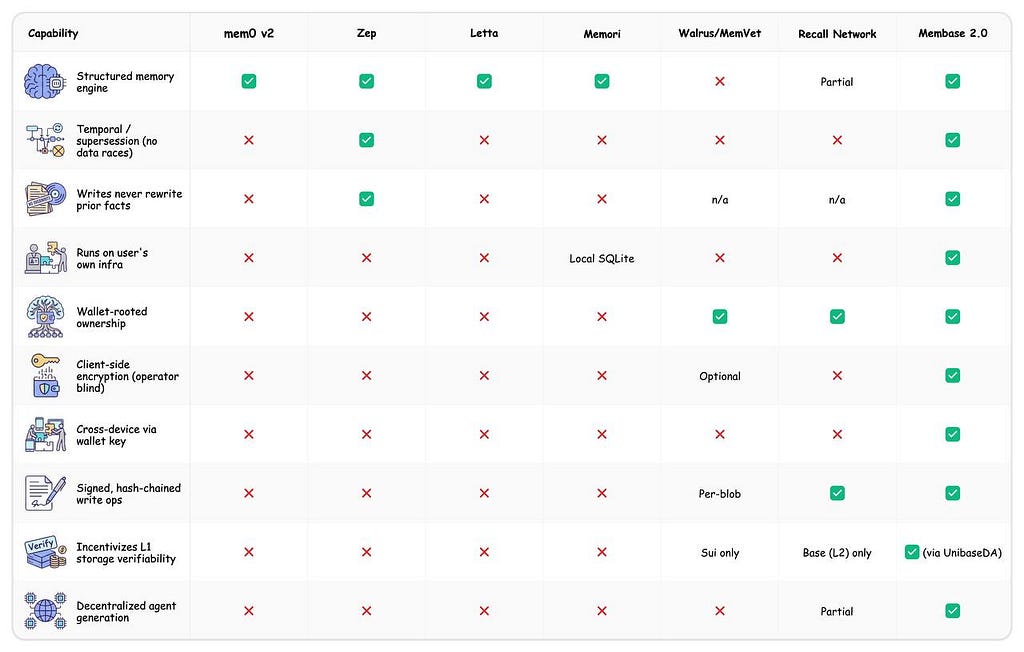
Membase 2.0 is not "mem0 redone with Web3 plumbing" and it is not "Walrus with a memory SDK." It is the first system to combine:
- What centralized engines can't deliver — wallet-rooted ownership, cross-device + cross-AI portability, client-side encryption, L1-verifiable storage via UnibaseDA, multi-agent cooperation without a referee.
- What Web3 storage can't deliver — a real memory engine with supersession edges and temporal visibility filtering, where writes never rewrite prior facts.
1. The gap in the field
Agent memory today splits into two camps that don't talk to each other:
- Centralized engines (mem0, Zep, Letta, Memori, etc) have real memory engines — fact extraction, temporal graphs, multi-hop retrieval — but the operator owns the data, the user has no wallet identity, and there is no client-side encryption.
- Web3 storage with a memory pitch (Walrus MemWal, 0G, Storacha, Filecoin, etc) gives the user wallet-rooted ownership and on-chain anchoring. None of them ship a memory engine — they are blob storage with an SDK.
- Membase 2.0 is the first system to combine both at once. It runs a structured memory engine on the agent's own machine, under wallet-derived keys, with a hub that sees only ciphertext.
Headline: where each camp sits
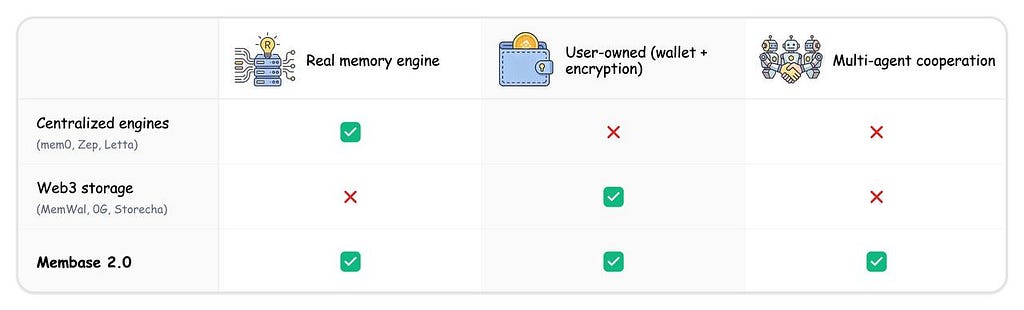
The third column — multi-agent cooperation — is its own pillar. No existing memory system has it; we unpack it after the storage layer.
2. What Membase gives the user
Three properties no other camp delivers together.
2.1 Memory that follows you across devices
The sync key is derived from your wallet's private key via KDF. Any device — phone, laptop, server — that holds the same wallet pulls the encrypted memory blobs from the hub and replays them locally. No platform sync server, no re-authentication, no platform key to provision.
- Centralized engines (mem0, Zep, Letta) tie your memory to the operator's database — "switching devices" means signing back into the same account.
- Web3 storage (Walrus MemWal, 0G INFT, Storacha) gives you wallet-owned blobs but doesn't ship the memory-specific sync semantics.
2.2 Memory that travels across AI tools
The agent that writes a memory and the agent that reads it don't have to be the same model, the same product, or the same vendor. The same memory store can be queried by Claude today, GPT tomorrow, a local Llama next week, or all three at once — they only need the Membase SDK.
- ChatGPT memory and Claude memory are vendor-locked: switching models loses context.
- mem0, Zep, Letta are vendor-portable in principle, but every agent that wants access has to be admitted to one operator-controlled database. Cross-organization access becomes an admin problem rather than a key-encapsulation problem.
2.3 Memory that you actually own
The memory lives on your machine. The hub sees only ciphertext encrypted under wallet-derived keys; only your wallet can decrypt.
- The operator cannot read it, delete it, audit it, or use it for training.
- Centralized engines store memory in operator-readable form by definition.
- Web3 storage gives you ownership over a blob but leaves private memory semantics to the application.
3. Storage layer: provable, not just trusted
Centralized memory engines park your data in an operator's database — you have to trust the operator. Web3 storage memory pitches (Walrus MemWal, 0G, Storacha) move the data onto a single chain's storage product but inherit that chain's economics and trust assumptions. Neither answers the question: "Can I, or anyone else, prove that my memory is intact and available, without trusting the hub?"
Membase answers it by running natively on UnibaseDA, the Unibase data availability layer.
- L1-enforced verification. Reed-Solomon encode and continuous-availability proofs are checked by Ethereum smart contracts. Other DA layers either rely on an off-chain operator quorum (EigenDA, 0G) or settle availability on their own chain (Celestia, Avail) rather than on Ethereum L1.
- Single-honest-party challenges. Any one party can challenge a bad encoding or a withholding event; the challenge is resolved on L1. Safe even if every other operator misbehaves.
- ZK access proofs. Read and write operations carry zero-knowledge proofs — access is auditable without exposing memory contents, the right property for private-by-default agent state.
What this gives memory above the hub: every memory blob a Membase SDK writes is independently re-verifiable by any third party against the L1 record. Audits don't depend on the hub operator being honest, or even alive.
4. Cooperative memory
Single-agent memory is solved (by mem0, Zep, Letta, et al.). Memory shared between agents, across trust boundaries, without a central referee — is not. This is the third axis of Membase 2.0 and the dimension no existing memory system covers.
The existing options for multi-agent coordination all break under decentralization:
- In-process frameworks (AutoGen, MetaGPT, CAMEL, CrewAI) work in one Python process. Across devices or trust boundaries you need a central orchestrator.
- BFT consensus (Tendermint, PBFT, Olas) needs f < n/3 byzantine nodes — two-agent sessions don't even exist in this model.
- Recall Network anchors agent behavior on-chain, but it targets public reputational use cases (Arenas, prediction markets), not private cooperation between two specific agents.
Membase makes shared memory itself the cooperation channel. The same Persistence Layer that holds private memory also holds public, signed, hash-chained logs and group-shared K/V — so coordination doesn't need a new system; it reuses the storage primitives already there.
- Each entry carries a wallet signature, a hash pointer to the previous entry, and horizontal references that pin what the author had observed at write time.
- A session is opened by writing an anchor entry; all session participants reference the anchor; the session terminates on an entry-count budget, not a wall-clock deadline, so a silent participant cannot stall the round.
- The outcome is a pure function of the merged session view. Any third party with only the hub's entries can replay the session and reach the same verdict.
Two agents plus a passive store that holds and returns bytes are enough to run auctions, commit-reveal games, votes, escrows, and long task hand-offs — with no central referee. When the backend is UnibaseDA, the same logs that record cooperation are also independently re-verifiable on Ethereum L1 — every move in every session is auditable, by anyone, forever.
5. Full comparison